
How to Check Criminal History in Blanco
Begin with the city office that made the record. Blanco Police keeps its incident material, Municipal Court keeps city ordinance and Class C cases, and the Blanco County jail creates a separate booking record after a custodial arrest. Class A and B misdemeanors move to the constitutional County Court, while felonies move to the 33rd or 424th District Court. The event number, citation number, date, place, full name, and issuing agency keep each request narrow enough to find.
- Read the citation or paperwork for the agency and identifying number.
- Ask Blanco Police or City Hall for the exact incident record.
- Review Municipal Court's dated dockets or call its clerk.
- Use the county jail and correct clerk for a booking or higher charge.
- Use Texas DPS for reported statewide conviction and deferred-adjudication history.
A search should follow time as well as jurisdiction. Police may have an incident number before a prosecutor selects a charge. The jail may confirm custody before any clerk has opened a case. Municipal Court may post a hearing PDF without yet showing the final action. A certified disposition comes from the court, not police. When a name search produces a doubtful match, compare the local judgment with a fingerprint-based personal review through Texas DPS instead of assuming that similar names identify the same person.
Blanco City Records at 300 Pecan
Blanco City Hall and Municipal Court are at 300 Pecan Street, Blanco, Texas 78606. The city and court line is 830-833-4525, with extension 104 for court matters. This is the current city records counter, not the historic Old Blanco County Courthouse and not a Blanco County clerk counter.
The official City of Blanco site shows its civic offices and department routes.
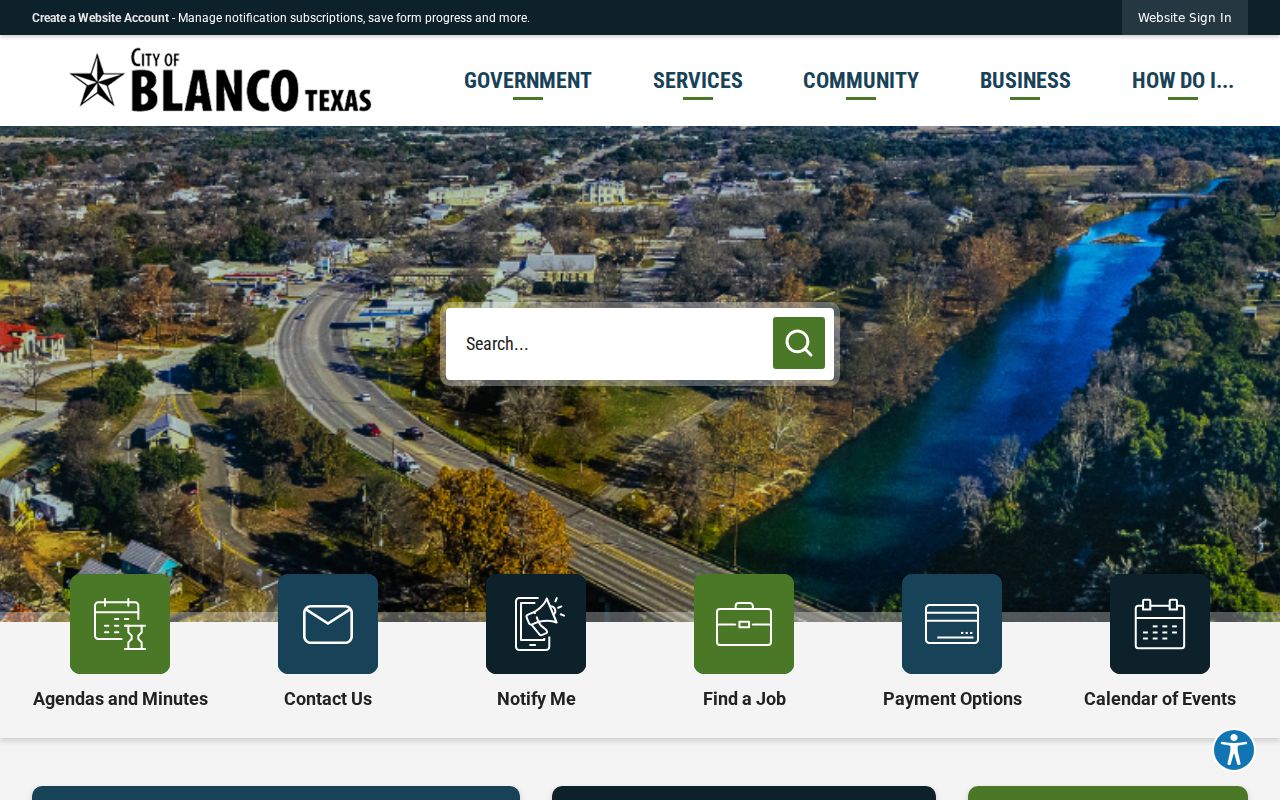
The city view helps a searcher separate Blanco Police and Municipal Court records from county records held in Johnson City.
The Blanco Police Department
Blanco Police handles city incidents from 105 South Main Street. Call 830-833-4525; the city directs after-hours police contact through the Sheriff at 830-868-7104. No official searchable Blanco arrest log, police-report portal, or agency app was verified. A focused written Texas Public Information Act request or direct city contact is therefore the proper route.
Supply requester contact details, incident number if known, date and time, location, involved person, the exact item sought, delivery preference, and willingness to receive a cost estimate. Ask about active-investigation, juvenile, family-violence, victim, or body-camera redactions. The city emergency-services page confirms the police contact.
Describe media with care. A body-camera or dispatch request should give the date, approximate time, place, officer or call if known, and a narrow span. A report can contain public basic information while other portions require legal review. Redaction does not mean the event is absent. If the city seeks clarification or sends a cost estimate, narrowing the date, record type, and delivery format can reduce delay without changing the record sought.
Blanco Police File or Booking Record
The city police report and county booking sheet are separate records. Blanco Police retains its narrative and media. The Sheriff keeps jail intake and custody details after a custodial arrest. Transfer to Johnson City does not transfer the full police report to county custody.
| Record | Custodian | Best identifiers |
|---|---|---|
| Incident report | Blanco Police | Incident number, date, place |
| Booking record | Blanco County Sheriff | Name, booking date, agency |
| City case | Municipal Court | Citation and hearing date |
| Higher charge | County or District Clerk | Cause number and filing date |
Ask the actual creator first. Shared dispatch does not erase custody boundaries.
Arrests and Bookings in Blanco
Blanco does not advertise a municipal jail. A custodial Blanco Police arrest is traced through the Blanco County Sheriff's Office and jail at 400 US Highway 281 North in Johnson City. Call 830-868-7104 with the full legal name, date of birth, likely booking date, and arresting agency. There is no verified official daily online county booking log.
If phone staff cannot release the detail, use the county public-information request for the booking sheet or named releasable fields. Ask Blanco Police separately for the incident report. Later, ask the correct clerk about filed charges because the police charge can differ from the prosecutor's final filing.
A recent arrest can leave several timestamps: police contact, arrival at jail, magistration, release, prosecutor filing, and the first court setting. Those times need not match. The absence of a case on the same day does not erase the police or booking record. Conversely, a citation may create a court matter without a custodial booking. Ask for the particular record and date rather than treating “arrest history” as one document.
Searching Blanco's Dated Court Dockets
The Blanco Municipal Court page publishes docket, show-cause, and jury-trial PDFs by hearing date, including sets spanning 2024 through scheduled 2026 dates during research. This is a useful transparency channel, but it is not a full party-name database. Each PDF is a date snapshot and may not show later amendments or a final result.
If a citation is missing, call with the name, citation number, date, and issuing agency. Absence may mean that another hearing date applies, the charge has not arrived, or a different court has jurisdiction.
Blanco Municipal Court Records
The court processes city ordinance violations and Class C misdemeanors. It posts dated dockets and links plea, driver-safety-course, community-service, and online citation forms. FastGovPay is a payment channel, not a complete criminal-history search. A payment or plea can affect the case, so a requester who only wants a copy should clearly say “public record request.”
A municipal record can show the citation, charge, plea, settings, orders, payment, and final action that the court actually filed. It will not supply the full police narrative, county jail intake, or a district felony file. Court staff cannot give legal advice, but they can identify the channel for a record and explain whether a charge has reached the docket. Ask whether a copy is ordinary or certified, since certification is a clerk function and may carry a separate current cost.
| Court | City of Blanco Municipal Court, 300 Pecan Street |
|---|---|
| Cases | Ordinance, traffic, and Class C misdemeanor matters |
| Lookup | Dated PDFs, telephone, or clerk counter |
| Docket | Hearing-date entries; confirm later activity with the clerk |
| Copies | Ask for the current delivery method and any cost estimate |
Blanco Court Forms Are Not Searches
The Plea Form, Driver Safety Course Request, Community Service Sheet, and citation-payment instructions serve distinct legal or compliance steps. None is a general record request. The plea form records a choice; the driver-safety request depends on eligibility and a deadline; payment can dispose of a matter.
For a copy, identify the docket or citation and name the document needed. This avoids an accidental legal response when the goal is to review the record. Signing a citation is a promise tied to the court process, while a public-record request simply asks for an existing document. Keep those acts separate. Read the current form, its deadline, and its consequences before submitting anything that selects a plea, requests a driving course, or pays a citation.
Where Blanco Records End Up
Blanco Police retains its report, the jail creates its own intake file, and prosecutors route charges by level. Fine-only city matters stay in Municipal Court. Class A or B misdemeanors go to the constitutional County Court, and felonies go to the 33rd or 424th District Court. Reportable events later enter the DPS statewide history.
Record flow: Blanco Police › Blanco County Courts › Texas Department of Public Safety
Use police and jail channels for recent activity, then the clerk after filing. DPS does not replace the local narrative or complete court file. The broader Blanco County criminal history overview explains those county systems at full depth.
Reporting lag explains many apparent conflicts. The arresting agency submits identity and fingerprint events in the state chain, while prosecutors and courts later send charging and disposition data. A dismissed or changed charge may appear differently in the police, jail, court, and DPS records because each custodian preserves its own function. For an incorrect statewide disposition, first obtain the local judgment, then ask the reporting clerk and DPS about correction. Do not assume that a local dismissal automatically removes every related record.
Old Blanco Courthouse, Current Records
The Old Blanco County Courthouse is part of city history, not today's county criminal-file counter. Historic Blanco records its past use as a courthouse, school, hospital, and museum. Current city matters go to City Hall and Municipal Court. Current county files are generally in Johnson City.
The county courthouse is under renovation, so confirm the temporary clerk address before travel. A document labeled “Blanco” may refer to the city, the county, the old courthouse, or a present city docket. Name the government body and record series in every request. The temporary County Clerk and District Clerk counters are at 101 East Cypress in Johnson City. A person looking for a current felony file should not use the old Blanco building or assume the historic 101 East Pecan county address is open. Check the official county notice on the day of travel.
Reading Blanco Crime Counts Carefully
Blanco had 1,811 residents in the 2020 Census. One or two incidents can shift a small-city rate sharply. For official context, select Blanco Police Department, the year, and the offense category in the Texas DPS crime reports. Do not substitute Sheriff's Office counts, which cover a larger jurisdiction.
State the raw count and reporting year beside any rate. Statistics describe agency reporting, not whether a named person has a record. Confirm that the agency participated in the chosen year and that the table measures the desired offense category. County Sheriff totals include territory beyond Blanco city limits, so labeling them as city crime would overstate the local scope. A rate is a context tool, not a substitute for an incident report, court docket, or certified disposition.
Small numbers also make year-to-year comparisons unstable. A change of only a few reported events can look large when divided by a population of 1,811. Use the count, year, agency, and reporting system together. Never infer guilt, current risk, or a person's history from an area-level rate.
Public Access Rules
City police and administrative records fall under the Texas Public Information Act, subject to exceptions and redaction for active cases, juveniles, victims, family violence, body-camera material, and sensitive identifiers. Judicial case records follow court-record rules, so send a case-file request to the clerk rather than using a broad city request.
The Act gives access to existing public information; it does not require an office to answer legal questions, create a new research report, or search every database for an open-ended name request. A precise request names the record series and event. If an exception applies, an office may release basic public portions while withholding protected detail or seek a ruling as the law allows. Court dockets, pleadings, and certified dispositions should remain with the court custodian even when the same event also produced a police report.
Key Statutes:
Texas Government Code Chapter 552 governs city public-information requests and exceptions.
Texas Government Code Chapter 411 governs computerized criminal-history dissemination.
Texas body-worn-camera resources describe special request and release rules.