
Criminal Cases in the Blanco County Courts
Blanco County criminal court cases split among several custodians. The 33rd and 424th Judicial District Courts hear felony matters, and the Blanco County District Clerk preserves those filings from the first pleading through disposition, appeal, and later proceedings. The clerk indexes filings, staffs hearings, collects court costs and fines, and issues court process such as a capias, which is a court order directing an arrest. County-level misdemeanors go to the constitutional County Court, whose records remain with the County Clerk.
Fine-only Class C charges and city-code cases may stay in a justice or municipal court. That means a blank county portal result cannot rule out a Blanco County case. The issuing court on a citation, complaint, or notice is the best clue. Appeals from the county go to the Third Court of Appeals, so an appellate docket is also separate from the trial clerk’s file.
Blanco County Felony Case Custodian
The District Clerk is the permanent custodian for felony files. Its published description of criminal-record duties confirms responsibility for filing, docketing, preservation, process, appeals, and archives. This matters when a web search displays only a thin index. Plea papers, bond terms, judgments, revocation filings, or certified copies may still require a direct request.
The official duties document can help readers identify the correct office before asking for a Blanco County criminal case record.
Review the District Clerk’s official responsibility statement shown here.

The captured page supports the clerk’s role as the source for felony filings rather than arrest or jail data.
How to Search Case Records
Start with the court level, then use the narrowest known identifier. The County Clerk links to Texas Online Records for county court material. Felony searches should go to the District Clerk by email or its signed form because no public, no-login Blanco County felony database was verified. Municipal and justice cases require the court that filed the matter.
- Classify the matter as felony, county misdemeanor, or municipal/justice-court charge.
- Select Blanco County in Texas Online Records for a county misdemeanor, and search by legal name or case number.
- For a felony, contact the District Clerk with the name, birth date if known, year range, cause number, and exact documents.
- For a ticket or Class C charge, contact the issuing municipal or justice court.
- Open the docket, confirm the court and disposition, then ask the clerk about copies or certification.
The hosted search controls can change, and portal coverage is not stated by the county. These are the inspected fields:
| Field | Type | Required | Use |
|---|---|---|---|
| County | Dropdown | Yes | Select Blanco County |
| Record category | Selector | Unspecified | Choose court records when offered |
| Name | Text | Search-dependent | Use the legal name |
| Case number | Text | Search-dependent | Best match when known |
| Date range | Date controls | Optional or unspecified | Narrows filing years |
The county-linked search landing page appears in this capture.
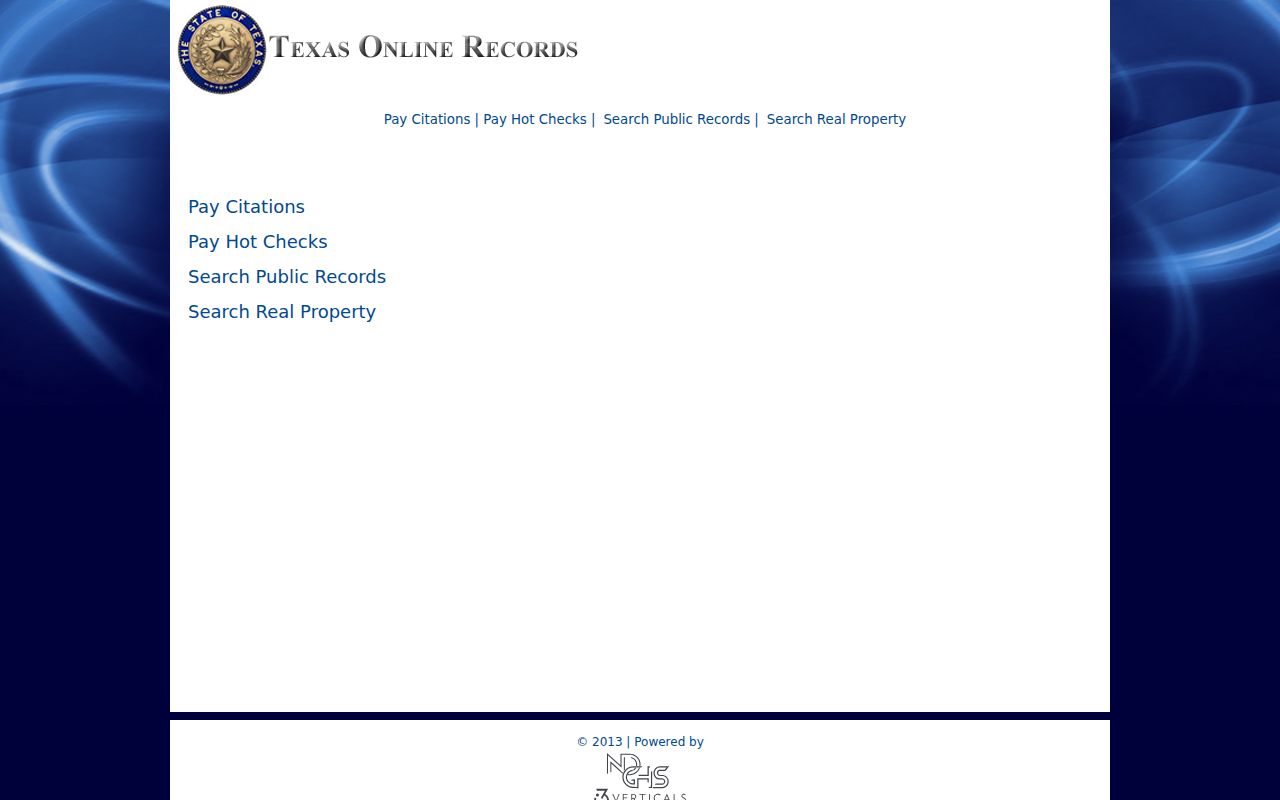
The interface is a starting index, not proof that every Blanco County court file or document is online.
Blanco County Criminal Records Form
When a felony result or document is missing, use the District Clerk’s Records Search Request Form. Mark Criminal Case, identify the subject, add a date of birth when known, state how far back to search, and list the exact papers wanted. The form requires a signature and date. Delivery may be mailed or emailed. Mailed copies require a self-addressed stamped envelope.
The printed fee is $5 per name searched. Payment choices on this form are check or money order. Copy and certification charges are not listed, and the form promises no turnaround time, so request an estimate. Mail the signed form to Blanco County District Clerk’s Office, PO Box 382, Johnson City, TX 78636. The clerk page also lists records-search email at mmadison@blancocountytexas.gov.
See the official $5-per-name request form in the image.

The form documents the mail, email-delivery, identifier, and payment fields needed for a targeted search.
What the Case File Shows
A Blanco County criminal court file can connect the filed accusation to its final result. It may contain far more than the portal index, but access can vary by document. Ask for the docket sheet first when the desired filing is unclear.
| Cause number and court | Identifies the prosecution and the district, county, municipal, or justice court. |
|---|---|
| Charging paper | A complaint, information, or indictment states the charge formally filed. |
| Docket entries | Chronological filings, settings, motions, orders, pleas, and later activity. |
| Bond material | Bond type, amount, terms, conditions, and related court orders when public. |
| Disposition and judgment | Shows dismissal, acquittal, conviction, deferred adjudication, or another outcome. |
| Sentence and appeal | May show confinement, supervision, fines, costs, restitution, and appellate steps. |
A cause number beginning with CR appears in official local forms, but a requester should still confirm the exact court and year. Grand-jury records, juvenile material, protected victim data, sealed papers, and other restricted content may not be public.
Read Blanco County Case Outcomes
Case status and case outcome are not the same. “Pending” means the prosecution has not reached a final disposition. “Dismissed” means the filed count ended without conviction. “Acquitted” follows a not-guilty finding. “Convicted” reflects guilt after a plea or trial. Deferred adjudication postpones a finding of guilt while the person completes court terms; it is not an acquittal. A “no-bill” means the grand jury did not return an indictment on the presentation.
- Complaint
- A sworn allegation that can begin a criminal matter.
- Information
- A prosecutor’s formal charging document, commonly used where indictment is not required.
- Indictment
- A grand jury’s felony charging instrument.
- Capias
- A court-issued order directing that a person be taken into custody.
Read the judgment or dismissal order whenever possible. A docket label alone can miss count-by-count outcomes, amended charges, or later revocation work.
Stages of a Criminal Case
A Blanco County criminal case does not freeze the arresting officer’s first description. Prosecutor screening may change or decline charges, and a grand jury may indict a different felony theory. Texas law requires an arrested person to be taken before a magistrate without unnecessary delay and no later than 48 hours. The magistrate gives warnings and addresses counsel and bail where lawful.
Case flow: Charges Filed › Arraignment › Pretrial › Plea or Trial › Disposition › Sentencing
Later records may include appeal, probation revocation, or a motion to adjudicate. Those events belong to the court file even though they occur after the first judgment.
Blanco County Electronic Court Recordings
The constitutional County Court uses electronic audio or audiovisual recording in covered civil and criminal proceedings. Under the county’s electronic-recording rules, the County Clerk or designee serves as recorder and keeps a dated, location-indexed log tied to the case.
A recording is different from the docket and filed pleadings. Someone seeking what was said in court should identify the case, hearing date, and desired format, then ask the clerk about access and any transcript or appellate-record process. The existence of a log does not make sealed or restricted content public.
re:SearchTX and Blanco County Cases
re:SearchTX offers a statewide court-record access layer, but account, court participation, and document availability can vary. Texas does not provide one free, comprehensive trial-court portal that replaces the Blanco County clerks. Compare any statewide result with the local cause number and custodian.
View the statewide re:SearchTX interface captured here.
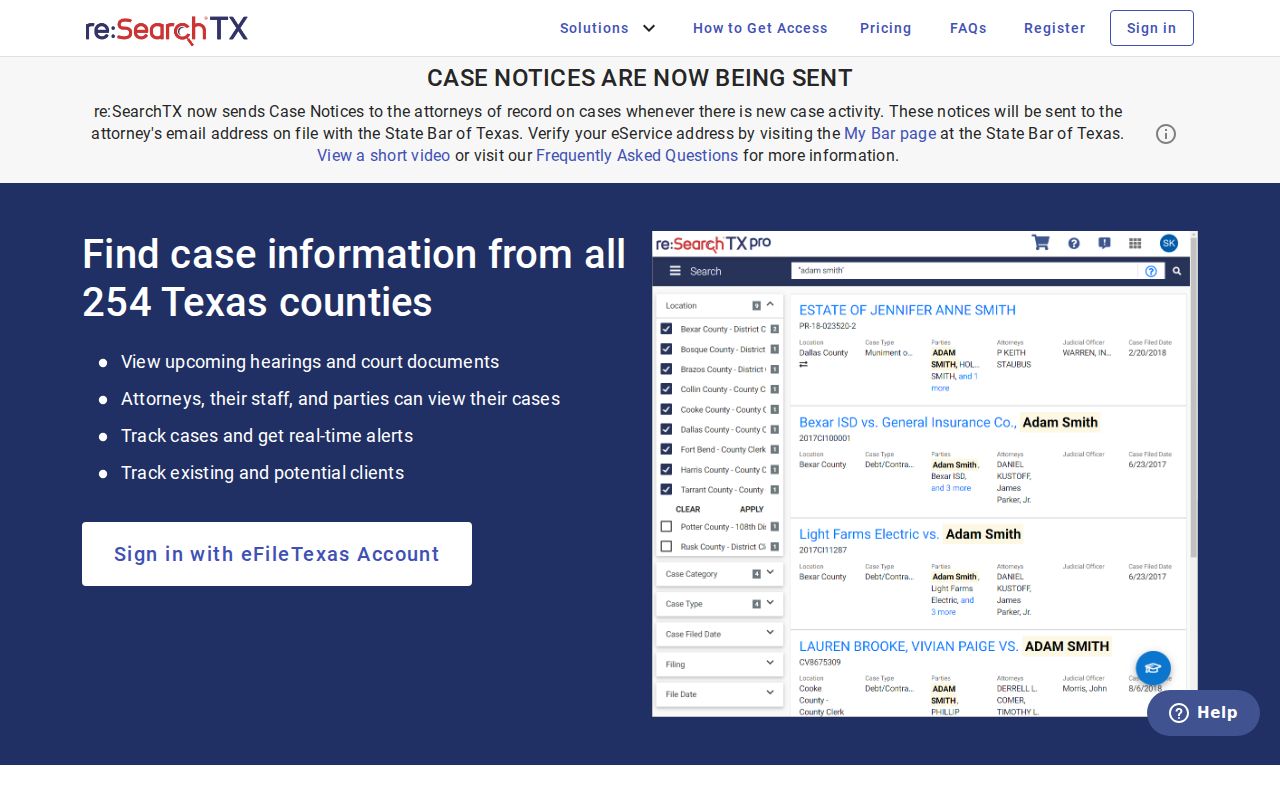
The image illustrates the supplemental search route while the local clerk remains the authority for a complete Blanco County file.
Access & Restrictions
Texas judicial records do not simply follow the Texas Public Information Act in the same way as agency administrative records. Court records of public judicial proceedings are also outside the computerized-criminal-history subchapter addressed by Government Code Chapter 411. Request the court case from its clerk first. Use the county’s public-information channel only as a fallback for an appropriate county-held administrative record, recognizing that court-access rules may govern the desired file.
Juvenile matters, sealed cases, grand-jury content, protected victim details, confidential identifiers, and some active filings may be withheld or redacted. A missing online case may also reflect the wrong court, older imaging, spelling, or portal limits rather than a sealed record.
Blanco County District Clerk
101 E. Cypress, Room 108
Johnson City, TX 78636
Mail: PO Box 382
830-868-0973
Mon-Fri 8:00-4:30, closed 12:00-12:30
Blanco County Clerk
101 E. Cypress
Johnson City, TX 78636
Mail: PO Box 65
830-868-7357
Mon-Fri 8:00-4:30
The official County Clerk page provides contact details and its online court-search route.

The captured office page directs county-level case inquiries to the proper Blanco County clerk.