
Running a Sex Offender Check in Blanco County
The Texas Public Sex Offender Registry is the main public channel for Blanco County. Texas Department of Public Safety Crime Records Division runs it, while local law enforcement collects registrations and sends updates to DPS. There is no separate Blanco County web registry. Select Blanco County, search a city or address, or use a person's name. Keep the full name, possible aliases, date of birth, and last known location close at hand when identity matters.
Local follow-up depends on residence. People living outside an incorporated municipality register with the Blanco County Sheriff's Office. Residents of Blanco or Johnson City register with the police chief or local law-enforcement authority. Call the correct office before relying on an address that appears stale. The registry is the fast public view, but the registration authority handles verification and suspected noncompliance.
Map Searches Across Blanco County
Rural Blanco County makes the location search especially useful. Enter a street address and radius, then inspect both the plotted points and the text addresses. A map marker can be approximate, and a postal city does not always prove that a place lies inside municipal limits. Search the county as well as Blanco and Johnson City when an address sits near a boundary.
The DPS name, address, and map form shows the actual controls used for this work.
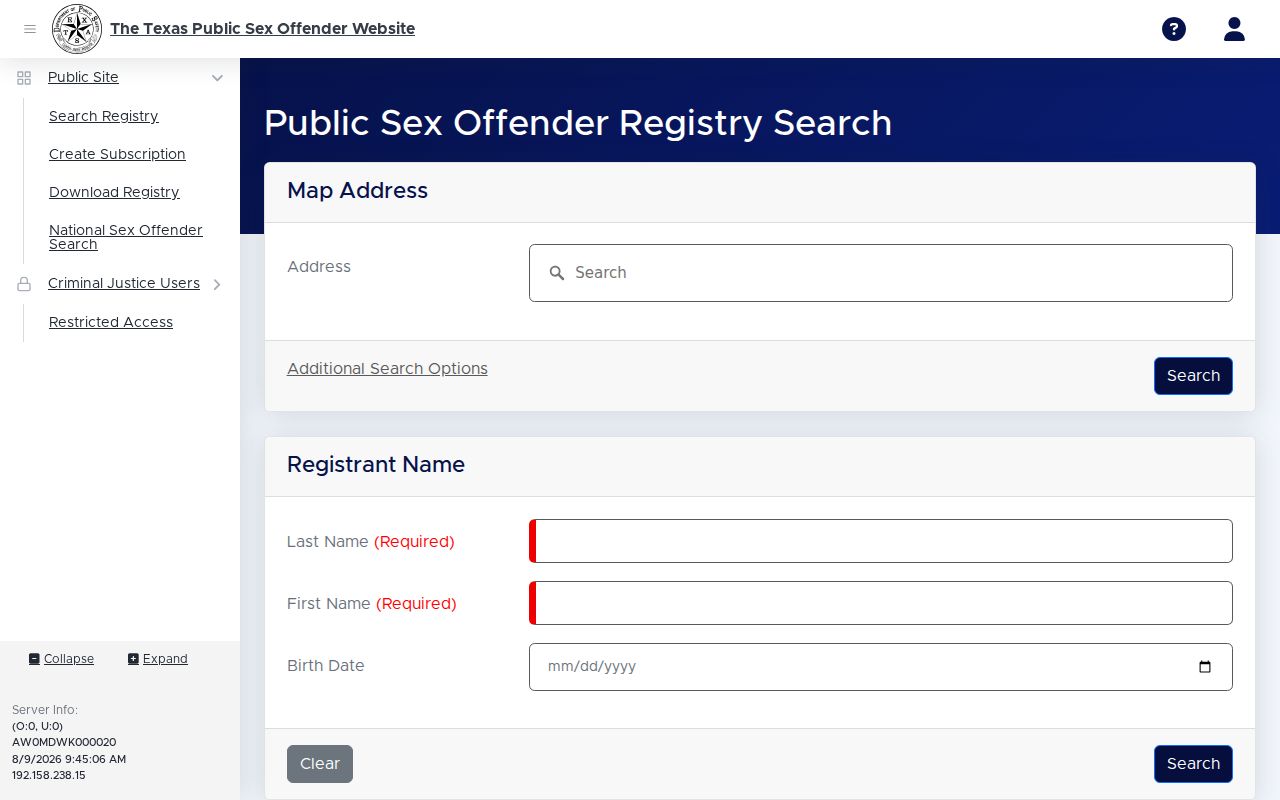
The screen demonstrates why a county filter and a radius search can find different sets of possible matches. Read the detail page before drawing a conclusion from a point on the map.
Searching the Texas Public Sex Offender Registry
DPS provides free name and geographic searches without an account. The database is a registration and public-notification system, not a list of every arrest, allegation, or sex-related criminal case in Blanco County. Browser scripting or acceptance of the warning may be needed. A no-result query is not final because spelling, aliases, moved addresses, jurisdiction, or reporting lag can affect a match.
- Open the DPS registry and read its conditions and warning.
- Choose a name search or enter an address, city, ZIP code, county, and radius.
- Compare aliases, age, photo, physical traits, and address among possible matches.
- Open the profile and read its status, authority, offenses, and update fields.
| Field Label | Type | Required | Notes |
|---|---|---|---|
| Last, first, middle name | Text | Conditional | Surname starts the name route; other names narrow it. |
| Address | Text | Conditional | Sets the center point for a geographic search. |
| City and ZIP | Text or assisted choice | No | Useful when a street address is incomplete. |
| County | Select | No | Choose Blanco County for a countywide result set. |
| Radius and map/list | Select and results controls | Conditional | Read the live distance and compare map points with profile addresses. |
Blanco County Search Beyond Texas
The Texas DPS result is the authoritative state detail, but it does not replace a search across other jurisdictions. The U.S. Department of Justice National Sex Offender Public Website routes a query across participating state, territorial, and tribal registries. Use it when a person or address history crosses the Texas line, then return to the originating registry for current detail.
The official NSOPW interface illustrates this national layer.
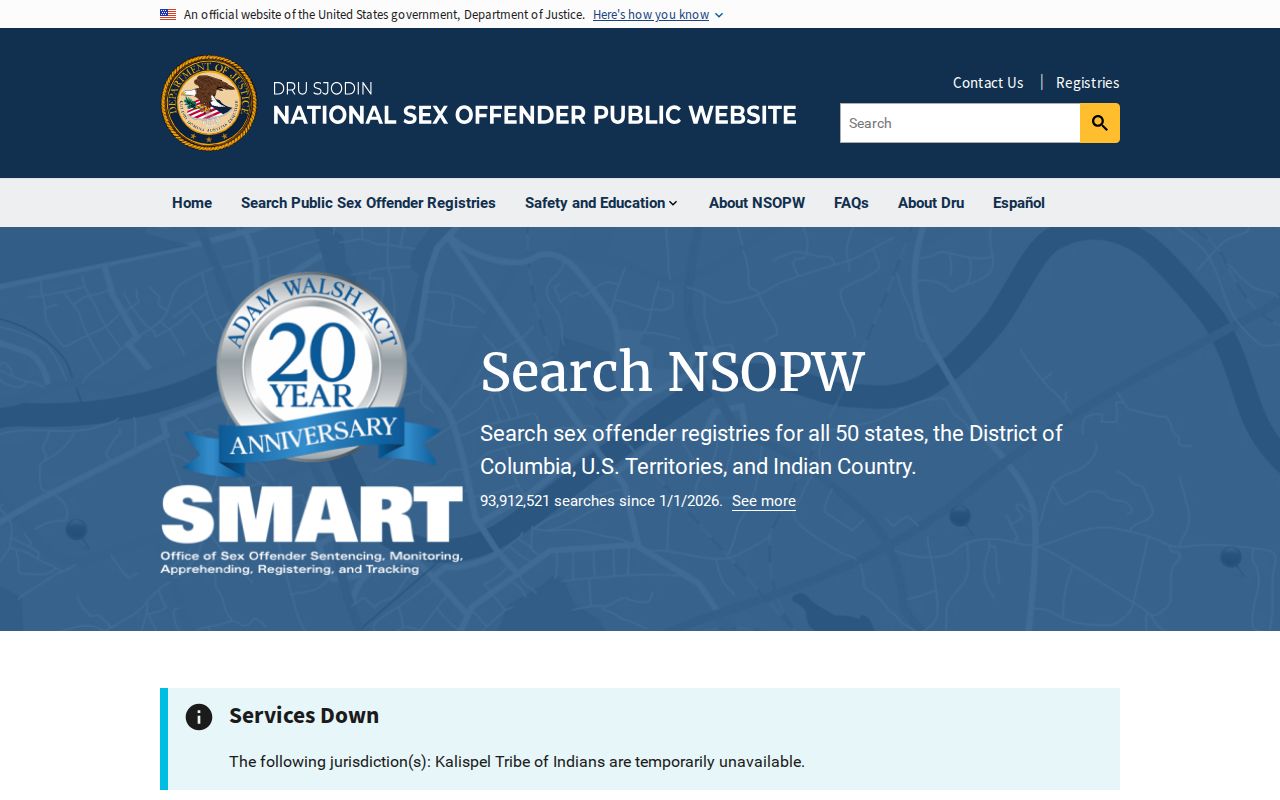
A national result still needs careful identity matching. Different jurisdictions can display different labels, update cycles, and public fields.
What a Registry Profile Shows
A public detail record ties the search result to identity, residence, offense, and registration information. Read each field literally. A risk level does not set the term of registration, a map point is not always an exact door, and an older photograph does not prove the rest of the record is stale. DPS withholds victim identity and several personal identifiers.
| Name and aliases | Primary name and reported aliases, plus sex, race, age or birth date where public. |
|---|---|
| Photo and description | Photo, height, weight, hair, eyes, and reported scars, marks, or tattoos. |
| Registered address | Street address or a detailed geographic location, with a map marker that may be approximate. |
| Offense | Description, jurisdiction, date, victim age without identity, and related disposition data. |
| Risk and authority | Texas risk level, registration authority, and status. These are distinct from federal tiers. |
| Update fields | Verification or address-update information that helps show how recently the entry was checked. |
Reading Blanco County Status Terms
Several dates can appear on one profile. The offense date, conviction or adjudication date, start of registration, last verification, and last record update describe separate events. Do not substitute one for another. The registering authority identifies the local office responsible for the record, while the risk label describes an assessed level of danger under the Texas tool.
- Risk level
- Texas numeric assessment of danger, not the length of the duty.
- Registration status
- The current official status notation shown by DPS.
- Civil commitment
- A court finding tied to intensive supervision and treatment, with more frequent verification.
- Last verification
- The recorded date of a required check-in, not a promise that every visible fact changed that day.
When an address looks out of date, do not confront the person. Give the local registration authority the profile reference and the specific concern.
Registration Requirements and Levels in Texas
Texas risk levels and registration terms follow different rules under Code of Criminal Procedure Chapter 62. Most registrants verify yearly. A civilly committed person verifies each 30-day period, while a person with two or more sexually violent offenses verifies every 90 days. The underlying offense and history control whether the Texas duty lasts for life or through a ten-year post-supervision period.
| Level / Tier | Duration | Verification Frequency |
|---|---|---|
| Level 1, low | Offense-based life or post-10 term | Generally annual |
| Level 2, moderate | Offense-based life or post-10 term | Generally annual |
| Level 3, high | Offense-based life or post-10 term | Generally annual, with enhanced notice |
| Civil commitment | Usually lifetime under underlying offenses | Every 30 days |
| Two or more sexually violent offenses | Generally lifetime | Every 90 days |
Blanco County Registration Offices
Registration is local even though the search is statewide. The Blanco County Sheriff's Office serves people outside incorporated municipalities from 400 US Highway 281 North, Johnson City, Texas 78636, at 830-868-7104. Blanco and Johnson City residents use the police chief or municipal law-enforcement authority. Call first because no county page publishes an appointment form, local fee, or fixed registry-counter schedule.
Blanco County Sheriff's Office
400 US Highway 281 North
Johnson City, TX 78636
830-868-7104
Unincorporated Blanco County registration and suspected noncompliance.
The initial registration deadline is generally no later than the later of the seventh day after arrival or the first date allowed by the authority's policy. Changes and moves carry their own deadlines. Confirm the applicable duty with the authority rather than relying on a general summary.
Blanco County Moves and Notification
A registrant planning a Texas move reports in person to the current authority no later than seven days before moving, then to the new authority no later than seven days after arrival. Repeated stays in another municipality or county can also trigger a report. DPS mails bilingual postcards in the immediate community for a high-risk registrant or civilly committed person due to move or be released there. Local authorities may use other public notice.
The Texas registry information page and warning supplies context beyond the result list.
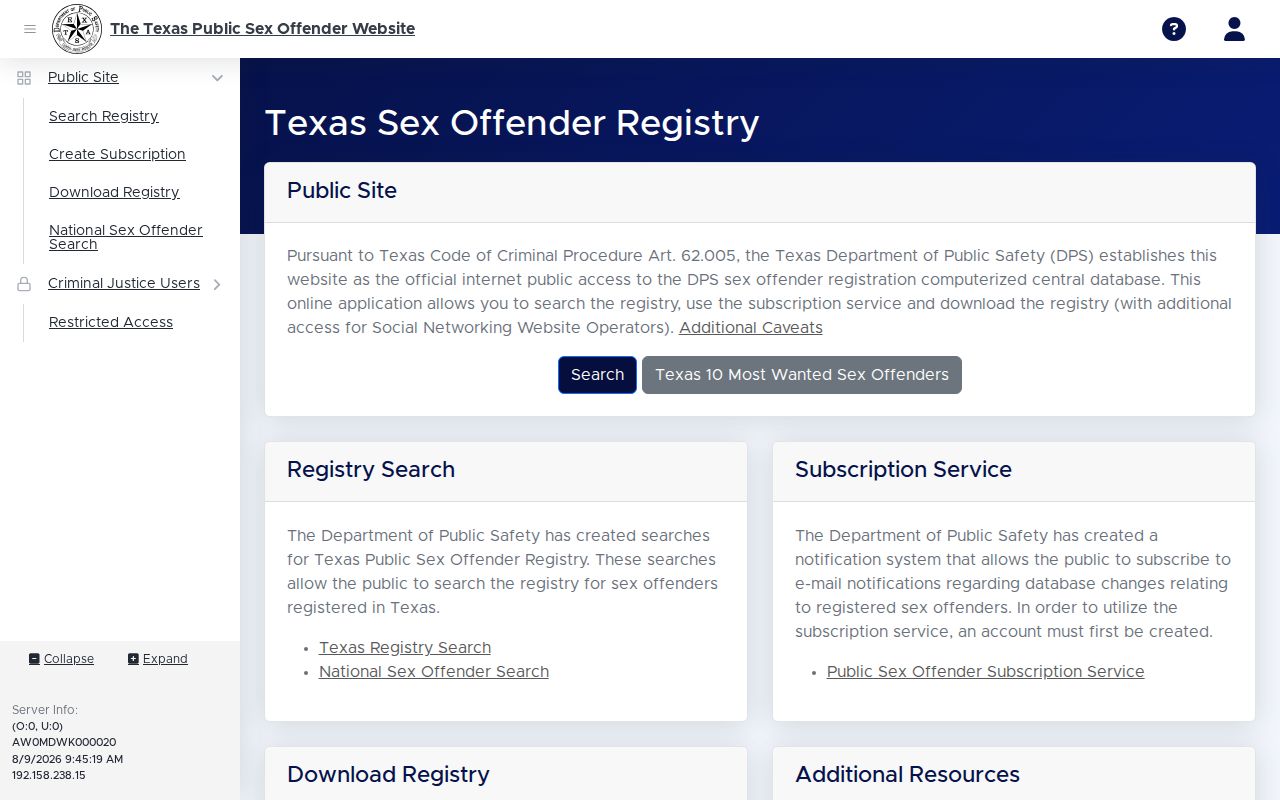
The warning reinforces that the data supports awareness and reporting, not confrontation. Texas does not impose one general statewide school or park distance buffer through Chapter 62, so check a city ordinance or supervision order before assuming a restriction.
Lawful Use and Community Notification
Use public registry data for personal, family, and community awareness. Compare identifying fields, note the update date, and report a suspected violation to Blanco Police, Johnson City Police, or the Blanco County Sheriff's Office based on residence. Immediate threats belong with 911. A missing or questionable record is a reason to contact the authority, not to investigate or confront a household.
Misuse can be a crime: Do not threaten, harass, stalk, trespass, assault, or damage property with registry information. Texas Penal Code Sections 42.07 and 42.072 and other criminal laws apply.